
August 18, 2026
How to Choose a Commercial Stainless Steel Work Table: Size, Material and Configuration
A commercial stainless steel work table looks simple, but the right table depends on far more than its appearance. Before comparing prices, buyers should match the table to available space, daily workflow, the equipment placed on top, the cleaning environment, required storage, expected load and overall budget. Appearance alone cannot tell you whether a table is suitable for commercial use — the specification does.
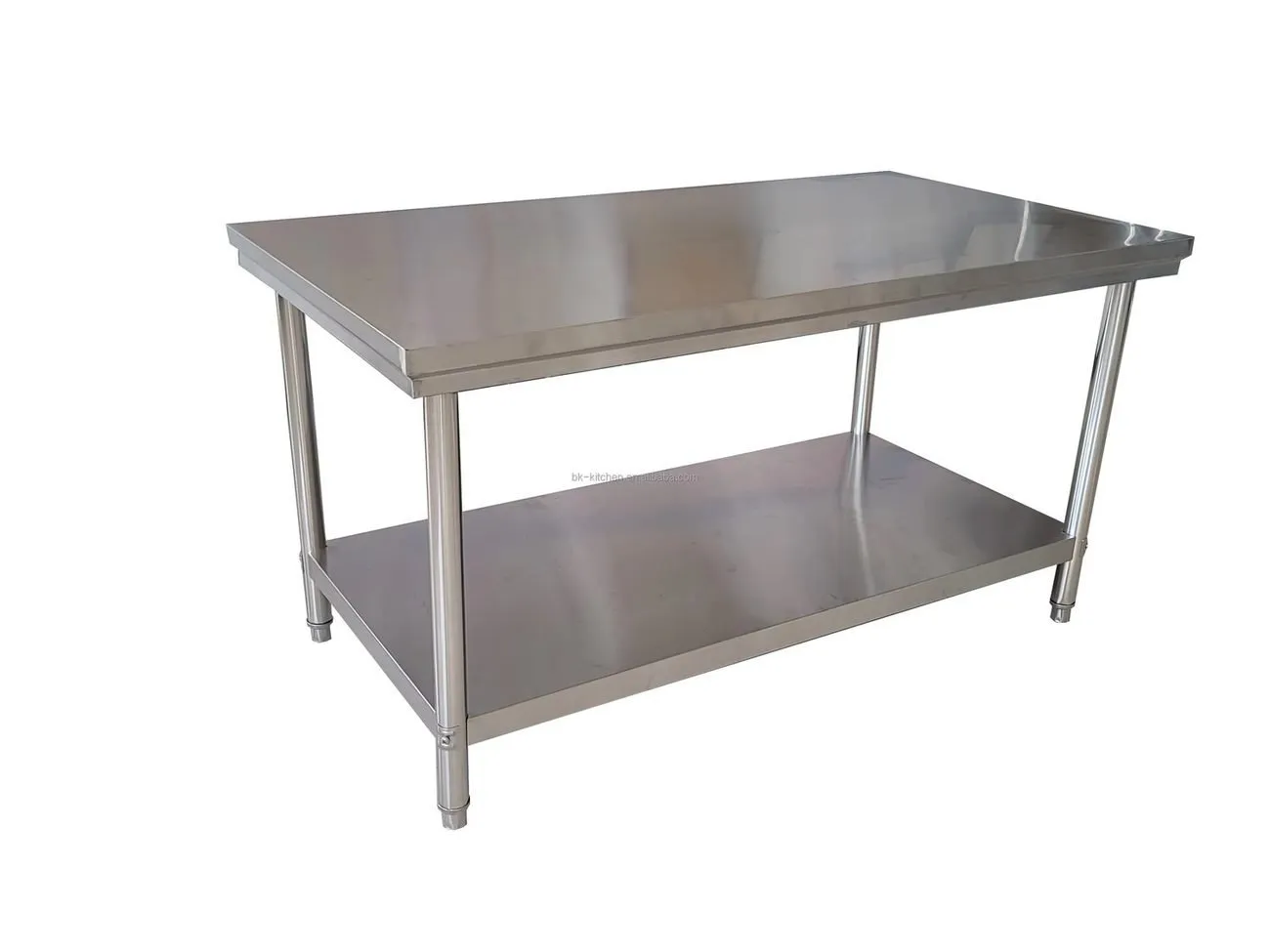
Start with the Installation Space and Workflow
Confirm the physical limits of the installation point before anything else. Buyers should record:
- Overall length — the longest horizontal dimension along the wall or island.
- Front-to-back depth — how far the table projects into the aisle.
- Working height — measured from the finished floor to the top surface.
- Door and aisle clearance — space needed to open nearby doors, drawers and pass-throughs.
- Position of nearby sinks, refrigerators and cooking equipment.
- Whether the table stands against a wall or in the center of the kitchen.
We recommend sending all dimensions in millimetres and attaching a simple floor plan or drawing. There is no universal standard size; the correct dimensions come from your layout, not from a catalogue number.
Choose the Right Stainless Steel Grade
Stainless steel is not one material; 304 and 201 behave differently in real kitchens.
- 304 is generally preferred for wet, humid and frequently washed areas such as prep lines, dish areas and near sinks.
- 201 can be considered for suitable dry indoor and budget-sensitive applications where corrosion exposure is low.
- Different components may use different grades when clearly specified — for example, a 304 top with 201 structural parts in a dry area.
For a detailed, specification-level comparison of how these two grades perform in commercial kitchens, see our guide: 304 vs 201 stainless steel for commercial kitchen equipment. The two articles are complementary: this one focuses on work-table configuration, not on repeating the grade comparison.
Confirm the Actual Stainless Steel Thickness
Top thickness affects rigidity, dent resistance and cost. A thicker top resists bending under heavy equipment, but finished strength also depends on the reinforcement below the top — channels, hat sections or full framing the sheet alone does not show.
The leg, undershelf and top may use different thicknesses, and that is normal. Buyers should request the actual thickness in millimetres for each component rather than relying on a single number.
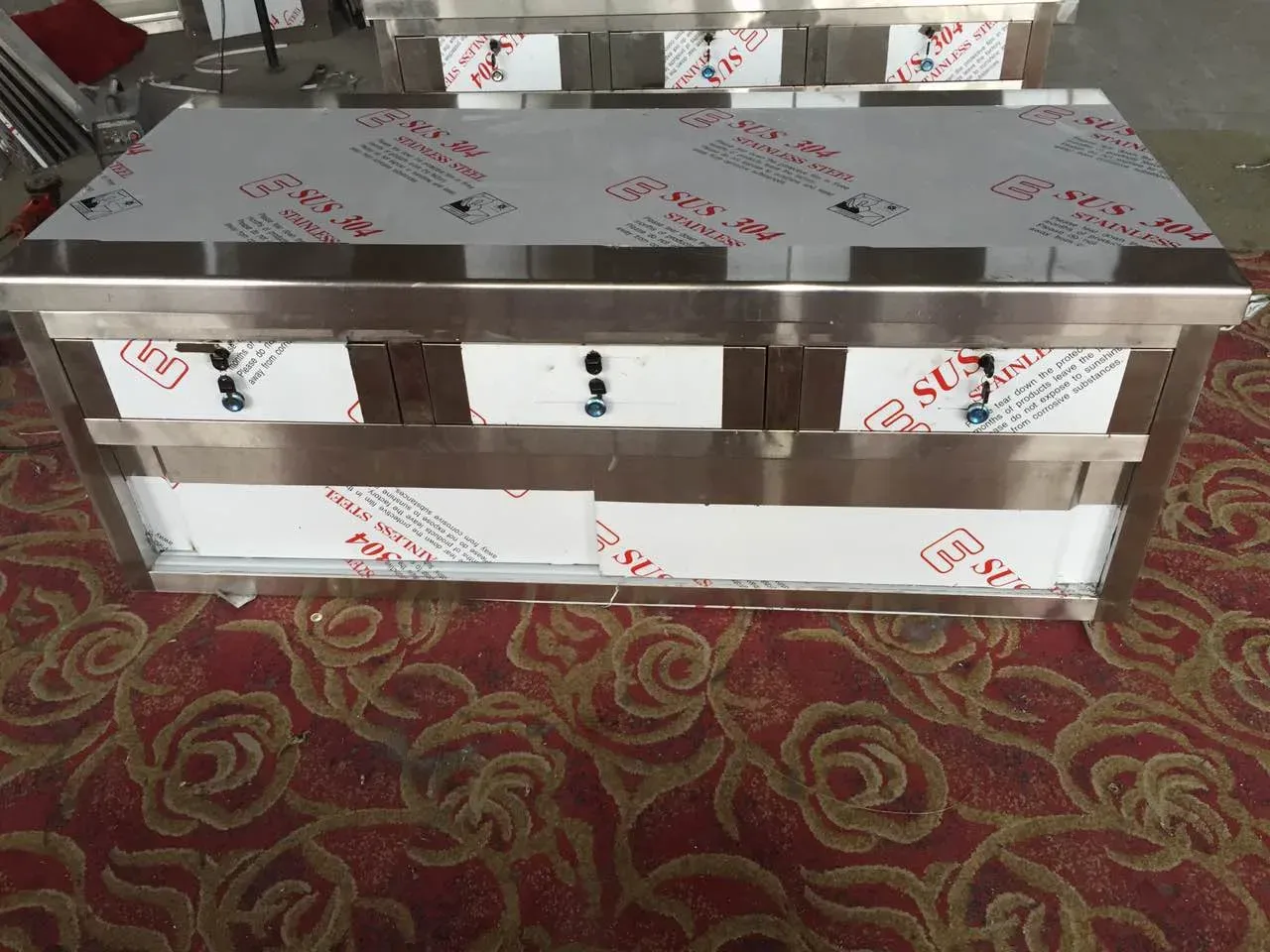
Important: do not treat gauge numbers as universally equivalent to one millimetre value. Gauge-to-thickness conversions depend on the gauge system and material type. To compare quotations accurately, buyers should ask suppliers to confirm the actual thickness in millimetres. If a supplier quotes 16 gauge or 18 gauge, ask them to confirm the actual millimetre thickness before you compare quotations.
Select the Worktop Design
The top profile changes how the table fits the surrounding area:
- Flat top — suitable for island placement and general preparation where no wall contact is expected.
- Backsplash top — a raised edge at the back helps protect the wall and contain minor spills.
- Upstand or side-splash options — useful beside walls or next to wet equipment to stop splash reaching adjoining surfaces.
- Reinforced top — important when supporting heavier countertop equipment such as mixers, slicers or combi-oven stands.
Remember that load capacity cannot be determined from the top sheet alone. Top thickness and reinforcement must be evaluated together. A reinforced top can provide better rigidity than the sheet thickness alone would suggest, so always review the full construction.
Choose the Storage Configuration
Storage under the top should follow your workflow, not the other way around. The table below compares the common options.
| Configuration | Best application | Main benefit | Space / cleaning note |
|---|---|---|---|
| Open base | Light prep, easy floor cleaning | Maximum clearance and simplest cleaning | Nothing to store underneath; floor must be kept clear |
| Adjustable undershelf | Variable stored items | Shelf height adapts to pans and containers | Slightly more to clean; height must stay clear of floor |
| Fixed undershelf | Stable, repeated storage | Simple construction and stable storage support | Fixed height limits large items |
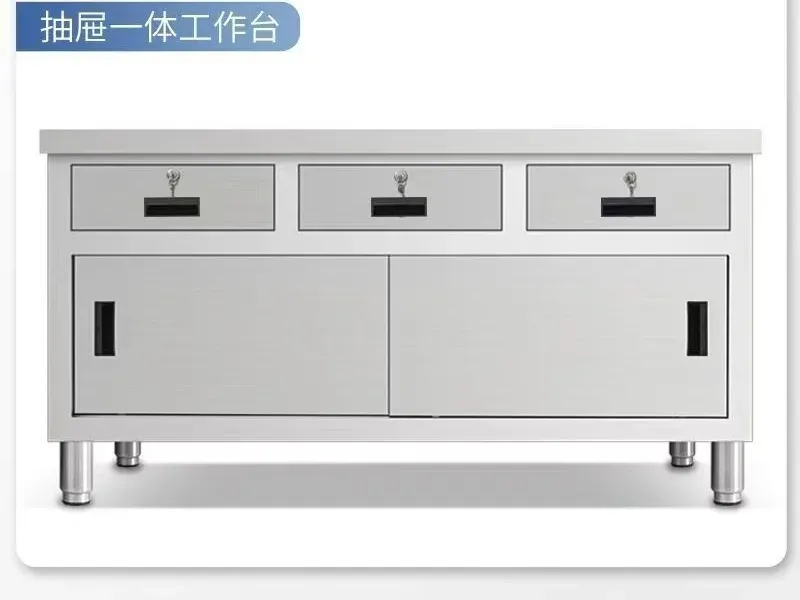
| Drawers | Tools, small utensils, papers | Organised and more enclosed storage | See our work table with drawers; drawers need clearance to open |
| Hinged-door cabinet | Enclosed, presentable storage | Clean front appearance, protects contents | Doors need swing clearance |
| Sliding-door cabinet | Tight aisles | No door swing space required | Tracks need periodic cleaning |
| Drawers + cabinet combination | Mixed storage needs | Flexible organisation | More components to specify and maintain |
For a simple layout, our standard work table is a common starting point; add drawers or cabinets based on what you store.
Legs, Feet and Casters
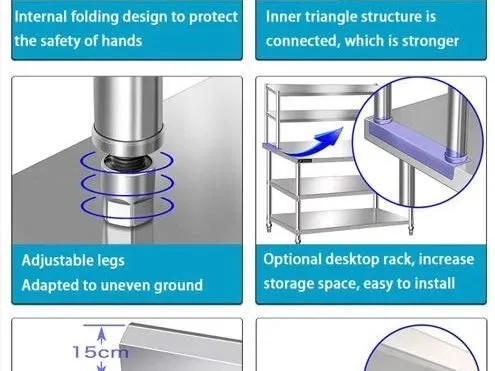
The base hardware decides how the table sits and moves:
- Adjustable feet help level the table on uneven floors and are common in real kitchens.
- Fixed feet suit stationary installations on a flat, stable floor.
- Casters support mobile workflows such as cleaning or re-layout.
- Caster load ratings must match the total loaded weight of the table and everything on it.
- Braked casters are important for stability during use — lock them before the table is loaded or worked on.
Do not assume any caster fits any load. Confirm the rated capacity against your actual loaded weight.
What Determines Work Table Strength?
Strength is a system, not a single number. Key factors include:
- Frame construction — tubular, box or channel frames behave differently.
- Underside reinforcement — the structure directly beneath the top.
- Leg diameter or profile — larger and boxed profiles resist sway.
- Cross bracing — stabilises the base against racking.
- Weld quality — poor welds are the usual failure point.
- Shelf attachment — how the undershelf connects to the legs.
- Caster or foot quality — the contact point with the floor.
- Overall dimensions — longer and deeper spans need more support.
If a supplier calls a table “heavy duty,” ask for an actual construction specification or verified load information. The label alone is not a measurable property.
Quality Details Buyers Should Inspect
Before accepting a shipment, check these points:
- Weld finishing — smooth, continuous and food-safe.
- Sharp-edge removal — no exposed burrs.
- Flatness of the top — no visible warp.
- Surface finish consistency — no uneven polishing or scratches.
- Reinforcement position — present where the load is expected.
- Leg and shelf stability — no wobble.
- Adjustable-foot operation — turns smoothly and holds.
- Drawer or door alignment — closes squarely.
- Protective film and export packaging — protects the product in transit.
These checks reflect how the table is made. See our commercial kitchen equipment manufacturing process for how we build and pack equipment.
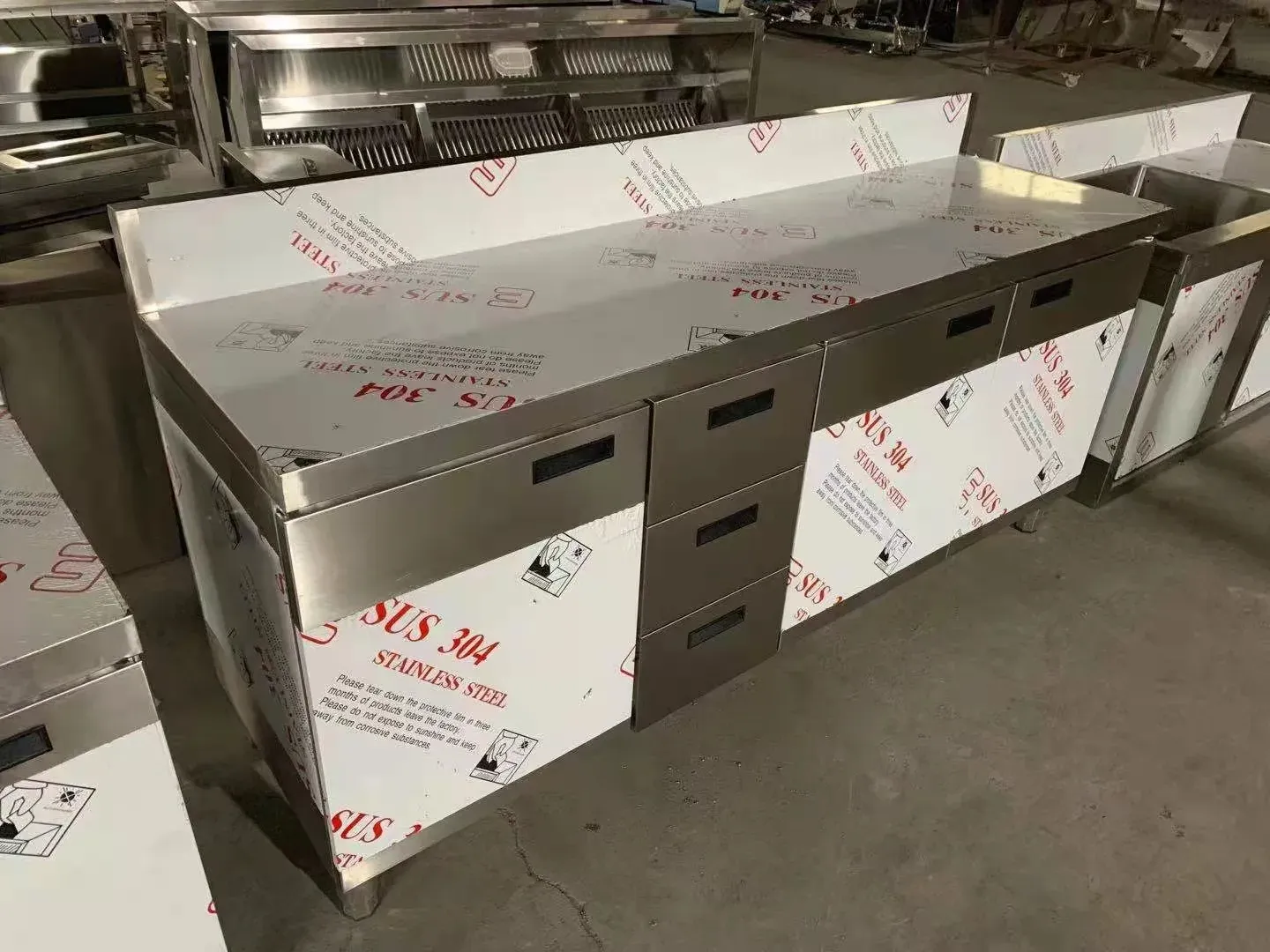
Information to Send When Requesting a Quote
A clear specification helps us return an accurate quotation quickly. Send the following:
- Overall dimensions: length × depth × height
- Required stainless steel grade
- Actual material thickness in mm
- Flat top or backsplash
- Open base, undershelf, drawers or cabinet
- Fixed feet or casters
- Equipment or expected load placed on the table
- Required quantity
- Destination country
- Drawing, logo and packaging requirements
Our Practical Recommendation
We suggest a balanced approach rather than a one-size answer:
- Use 304 for wet and demanding environments; consider 201 only where the application is suitable.
- Confirm thickness in millimetres, not gauge alone.
- Select storage based on your actual workflow.
- Ask for reinforcement and frame details, not just a “heavy duty” label.
- Send a drawing for customized projects so the table fits the space.
No single configuration is best for every buyer — the right table matches your kitchen, load and process.
Frequently Asked Questions
What is the best stainless steel grade for a commercial kitchen work table?
304 is generally preferred for wet, humid and frequently washed areas such as prep and dish zones. 201 can suit dry indoor, budget-sensitive applications. The right grade depends on the environment the table will actually face.
How thick should a stainless steel work table be?
There is no single correct number. Top thickness affects rigidity and dent resistance, but total strength also depends on reinforcement beneath. Always request actual thickness in millimetres for the top, legs and shelf, and avoid comparing gauge numbers across markets without confirming the millimetre value.
Is a backsplash necessary?
A backsplash is not always necessary, but it helps protect the wall and contain spills when the table sits against a wall or near wet equipment. For freestanding island tables, a flat top is often enough.
Can a commercial work table be fitted with drawers or cabinets?
Yes. Drawers, hinged-door and sliding-door cabinets and combinations are common. They keep items organised and protected, but need clearance to open and add parts to specify. See our work table with drawers for an example.
What information is needed for a custom work table quotation?
Send overall dimensions, required grade, actual thickness in mm, top type, storage configuration, feet or casters, expected load, quantity, destination country and any drawing or packaging needs. A simple floor plan lets us confirm fit before quoting.
Need a Custom Stainless Steel Work Table?
Send us your required dimensions, material grade, storage configuration and quantity. We can review the specification and prepare a factory-direct quotation.