
How to Choose a Commercial Stainless Steel Sink: The Complete Buyer’s Guide
July 25, 2026
How to Choose a Commercial Stainless Steel Sink: The Complete Buyer’s Guide
Size, material grade, installation, and maintenance — the five decisions that decide whether your sink lasts 20 years or 3.
Every commercial kitchen runs on its sinks. They are the first and last stop in almost every task — washing produce, thawing meat, scrubbing sheet pans, and running the three-compartment warewashing station that health inspectors check first. Yet most buyers get the specification wrong: the wrong grade rusts within a few years, the wrong size creates a workflow bottleneck, and a sloppy installation leads to leaks and failed inspections.
This guide walks you through the five decisions that actually matter when you buy a commercial stainless steel sink, so you can specify the right unit the first time and protect that investment for the long haul.
1. How to choose a commercial sink — start with workflow
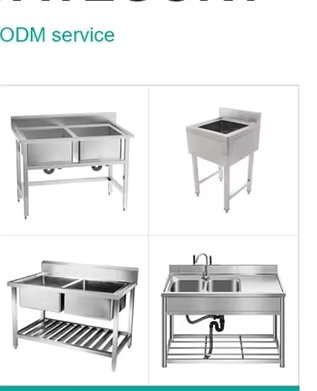
2. Commercial sink size guide (dimensions & compartments)
3. 304 vs 201 stainless steel — what you are really paying for
4. How to install a commercial sink
5. Commercial sink maintenance — keep it rust-free for years
Frequently asked questions
1. How to Choose a Commercial Sink — Start With Workflow
A commercial sink is not a basin; it is a workflow hub. Before you look at catalogs, answer three questions that dictate every downstream choice:
- What is the largest item you will wash? A 60 cm stockpot needs a different bowl than a bar glass.
- How many compartments does code require? Many health jurisdictions mandate a dedicated 3-compartment sink for manual warewashing and a separate handwashing sink. A sink that looks compliant on paper but fails inspection is not a bargain.
- How much space is actually available? Measure the floor footprint and the clearance you need for plumbing, faucets, and landing area.
From there, match the sink type to its job:
- Pot / utility sink — deep, single compartment (often 35–50 cm / 14–20″ bowl depth) for soaking and scrubbing large cookware.
- Prep sink — single or double compartment, shallower, used for washing vegetables, thawing, and handling ingredients.
- 3-compartment sink — the industry standard for manual dishwashing: wash, rinse, sanitize. Required in most kitchens without a commercial dishwasher.
- Handwashing sink — small, code-mandated, hands-free (foot pedal or sensor) where possible, placed near prep and restrooms.
- Bar sink — compact 1–2 compartment unit built to fit under the bar counter for glassware and ice.
2. Commercial Sink Size Guide (Dimensions & Compartments)
Commercial sinks are sized by compartments and bowl depth, not just overall length. Here are the typical footprints you will see from a factory (custom sizes are usually available):
| Sink type | Overall length | Bowl width | Bowl depth | Working height |
|---|---|---|---|---|
| Single bowl | 50 / 60 / 70 cm (20–28″) | 50–70 cm (20–28″) | 25–40 cm (10–16″) | 80 cm (34″) |
| Double bowl | 100 / 120 cm (40–48″) | 50–70 cm (20–28″) | 25–40 cm (10–16″) | 80 cm (34″) |
| Triple bowl | 145 / 175 / 180 cm (57–71″) | 50–70 cm (20–28″) | 25–40 cm (10–16″) | 80 cm (34″) |
| Pot / utility | 60–90 cm (24–36″) | 50–70 cm (20–28″) | 35–50 cm (14–20″) | 80 cm (34″) |
A simple sizing method:
- Measure your largest pot, pan, or sheet tray.
- Add 5–10 cm (2–4″) clearance on each side for handling.
- Choose bowl depth that comfortably covers your tallest item — 35–40 cm (14–16″) is the commercial standard; go deeper for pot sinks.
- Confirm the footprint fits your space with room for faucets, a drainboard, and plumbing clearance.
- Plan for growth — a slightly larger sink today avoids a costly replacement next year.
Most floor-standing units sit at a standard 80 cm (34″) working height on adjustable legs (typically 70–90 cm range), which lets you level the unit on uneven floors. Add a drainboard (left, right, or both) for staging dirty and sanitized items without cluttering the counter.
3. 304 vs 201 Stainless Steel — What You Are Really Paying For
This is the decision that separates a sink that lasts 20 years from one that rusts in 3. Both look identical in the showroom, but the alloy is completely different.
| Feature | 304 (premium) | 201 (economy) |
|---|---|---|
| Composition | 18% chromium + 8% nickel (18/8) | Lower nickel, more manganese |
| Corrosion resistance | Excellent — resists water, steam, acids | Prone to pitting / rust in humid or salty air |
| Typical lifespan | 15–20 years | 3–5 years, often rusts at drain & welds |
| Upfront cost | Higher | 20–30% cheaper |
| Hygiene | Smooth passive layer, resists biofilm | More magnetic, attracts metal particles |
| Weldability | Excellent (TIG, 304L filler) | Risk of hot cracking |
| Best for | Sinks, prep tables, wet/food zones | Dry shelving, racks, frames |
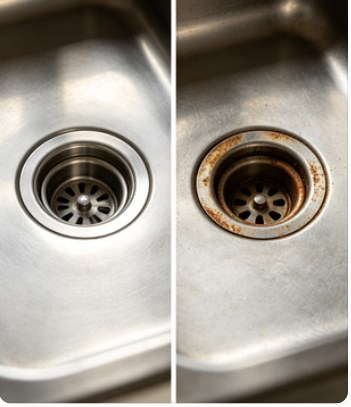
What the chemistry means in your kitchen: 304’s high nickel content forms a stable, self-healing passive layer that shrugs off water, steam, tomato acid, and citrus. 201 replaces much of that nickel with manganese to cut cost — and loses chemical protection in the process. In a coastal or high-humidity location, 201 can show orange rust spots within months, especially around the drain and welded corners.
The real cost math: 201 saves you 20–30% upfront, but a sink that rusts out in 3–5 years means removal, disposal, countertop adjustment, and re-installation — “buy cheap, buy twice.” For any surface that touches food or water, 304 is the smarter economic choice, not just the safer one.
Two quick checks before you buy
- Ask for a mill test certificate. Reputable suppliers confirm 304 content on paper. Vague labels like “stainless steel” with no grade are a red flag.
- The magnet test (rough, not scientific): 304 is largely non-magnetic; 201 is noticeably more magnetic due to its manganese content. If a magnet sticks firmly to a “premium” sink, question the grade.
4. How to Install a Commercial Sink
Most commercial sinks are floor-standing freestanding units with legs, a backsplash, and a drainboard — far simpler than an undermount residential sink. Wall-mounted and drop-in styles exist for tight spaces, but the install logic is the same.
Before you start:
- Confirm your plumbing: hot/cold water inlets, drain line, and — in most food-service sites — a grease interceptor on the drain.
- Verify the floor space and leave clearance behind the unit for the drain and supply lines.
- Have food-grade silicone sealant, a level, and an adjustable wrench on hand.
Installation steps:
- Position and level. Place the unit, extend the adjustable feet, and use a level to ensure the basin drains correctly.
- Connect the water supply. Attach hot and cold lines to the faucet (a gooseneck or pre-rinse faucet is standard for commercial use). Tighten by hand, then a quarter-turn with a wrench — do not overtighten.
- Connect the drain. Run the tailpiece to a P-trap and then to the building drain or grease interceptor, with a slight downward slope for flow.
- Seal the edges. Apply food-grade silicone where the backsplash meets the wall and where the rim meets the counter (for drop-in styles). This prevents water from seeping into cabinetry.
- Test. Run water, check every connection for leaks, and confirm full drainage before putting the sink into service.
5. Commercial Sink Maintenance — Keep It Rust-Free for Years
A quality 304 sink is built to last decades, but its lifespan depends on daily habits. The good news: the routine takes about 10 minutes at close.
Daily end-of-day routine (10 minutes):
- Rinse the basin with clean water after every use — especially after salty brines or acidic foods.
- Wash with mild soap and a soft cloth or sponge, always with the grain of the steel (look for the faint lines and wipe along them).
- Rinse thoroughly so no soap film is left behind.
- Sanitize per local code. In a 3-compartment sink: wash (≥43 °C / 110 °F + detergent), rinse (clean hot water), sanitize (hot water ≥77 °C / 171 °F for 30s, or an approved chemical sanitizer at the labeled concentration — verify with test strips).
- Dry completely with a soft towel. Air-drying is the #1 cause of water spots and mineral buildup, especially with hard water.

Weekly deep clean: use a baking-soda paste for stubborn stains, a 1:1 white-vinegar-and-water spray for hard-water film, and a food-grade stainless polish to restore shine.
DO: use a bottom grid or sink mat (protects the base from dents and lifts dishes for drainage), soft microfiber cloths, nylon brushes, and pH-neutral cleaners.
DON’T: use steel wool, abrasive powders, chlorine bleach, or any chloride-based cleaner (chlorides attack the chromium layer and cause pitting). Never leave a wet sponge sitting in the basin.
About those “rust spots”: stainless steel cannot rust on its own. The orange specks you see are almost always external iron particles — from water pipes, a steel scouring pad, or a tin can left in the sink — that have deposited on the surface. Remove them with a non-abrasive cleaner like Bar Keepers Friend, scrub gently with the grain, and rinse. The sink underneath is fine.
Periodically check faucet seals and the caulking around the rim; re-seal at the first sign of cracking to keep water out of the cabinet below.
Frequently Asked Questions
What gauge stainless steel is best for a commercial sink?
Is 304 or 201 stainless steel better for a kitchen sink?
Do I need a 3-compartment sink?
Can I install a commercial sink myself?
How do I stop my stainless steel sink from rusting?
How often should I deep clean a commercial sink?
Specify Your Commercial Sink With a Factory That Knows the Grade
Full Kitchen (Shandong Fullkitchen Equipment Factory) manufactures 304-grade commercial stainless steel sinks — single, double, and triple compartment, hand sinks, prep sinks, and pot sinks — in customizable sizes with OEM/ODM support. Tell us your workflow and space, and we will specify the right gauge, compartments, and layout.
Request a Quote
WhatsApp: +86 137 9388 6893
Email: sales@kitchenmfg.com